Estimate based on distance bands and average operations—not a measurement of a specific aircraft. Toggle wider climate effects off to see combustion CO₂ only.
Free · No signup · No personal data stored · Clear planning estimate
Flight emissions at a glance
How much CO₂ does a flight produce?
A flight's carbon footprint is the passenger's share of emissions from the journey. It depends on distance, route, cabin class and whether wider high-altitude climate effects are included. Use the calculator above for your itinerary; its result is an estimate, not a measurement of a specific aircraft.
Output
kg CO₂ or kg CO₂e
Route model
Great-circle distance + 8%
Uncertainty
A visible ±20% range
What changes the answer?
Distance is only the start.
A useful estimate accounts for the route, the seat you occupy and the extra climate effects of flying at altitude.
Route and connections
Longer routes burn more fuel. A stop adds distance plus another take-off and climb, so direct is normally the lower-carbon choice.
Cabin floor space
A premium seat takes more room. Fewer people share the aircraft’s emissions, increasing the footprint allocated to each passenger.
CO₂ or wider impact
Contrails and other non-CO₂ effects add warming but carry more uncertainty. The calculator lets you view the result with or without them.
Transparent methodology
How the estimate works.
We deliberately show an estimate and range. No public calculator can know the final aircraft, load, wind and routing for a future flight.
1
Measure the route
We calculate the shortest path over the curved Earth, then add an 8% route uplift for real-world routing and operational distance.
2
Apply a distance band
Short, medium and long flights use different average emissions per passenger-kilometre because take-off matters more on short journeys.
3
Allocate cabin space
Economy is the baseline. Premium economy, business and first receive progressively larger shares based on the space their seats occupy.
4
Choose the climate boundary
The default result includes a 1.7 multiplier for wider aviation effects. Turn it off to view direct combustion CO₂ only.
Worked examples
Example flight carbon footprints.
Approximate return economy results for one passenger, including the calculator's 1.7 wider-climate multiplier.
Example estimated return flight emissions by route
Route
Return distance
Estimated footprint
Without wider effects
London–Paris
~690 km
~104 kg CO₂e
~61 kg CO₂
New York–Los Angeles
~7,870 km
~1,228 kg CO₂e
~722 kg CO₂
London–New York
~11,140 km
~1,739 kg CO₂e
~1,023 kg CO₂
London–Dubai
~11,000 km
~1,717 kg CO₂e
~1,010 kg CO₂
Rounded planning estimates using this page's published factors. Actual aircraft, load, weather and routing can move the result outside the displayed range.
Read the result honestly
What this estimate can and cannot tell you.
Use the number to compare routes, cabins and trip choices. Treat the displayed range as more meaningful than the final kilogram.
Method reviewed 15 July 2026. TripMemo is independent of ICAO and the UK government. This personal planning estimate is not licensed ICAO output or formal reporting advice.
TripMemo for iPhone
Your footprint is one number. Your trip is the story.
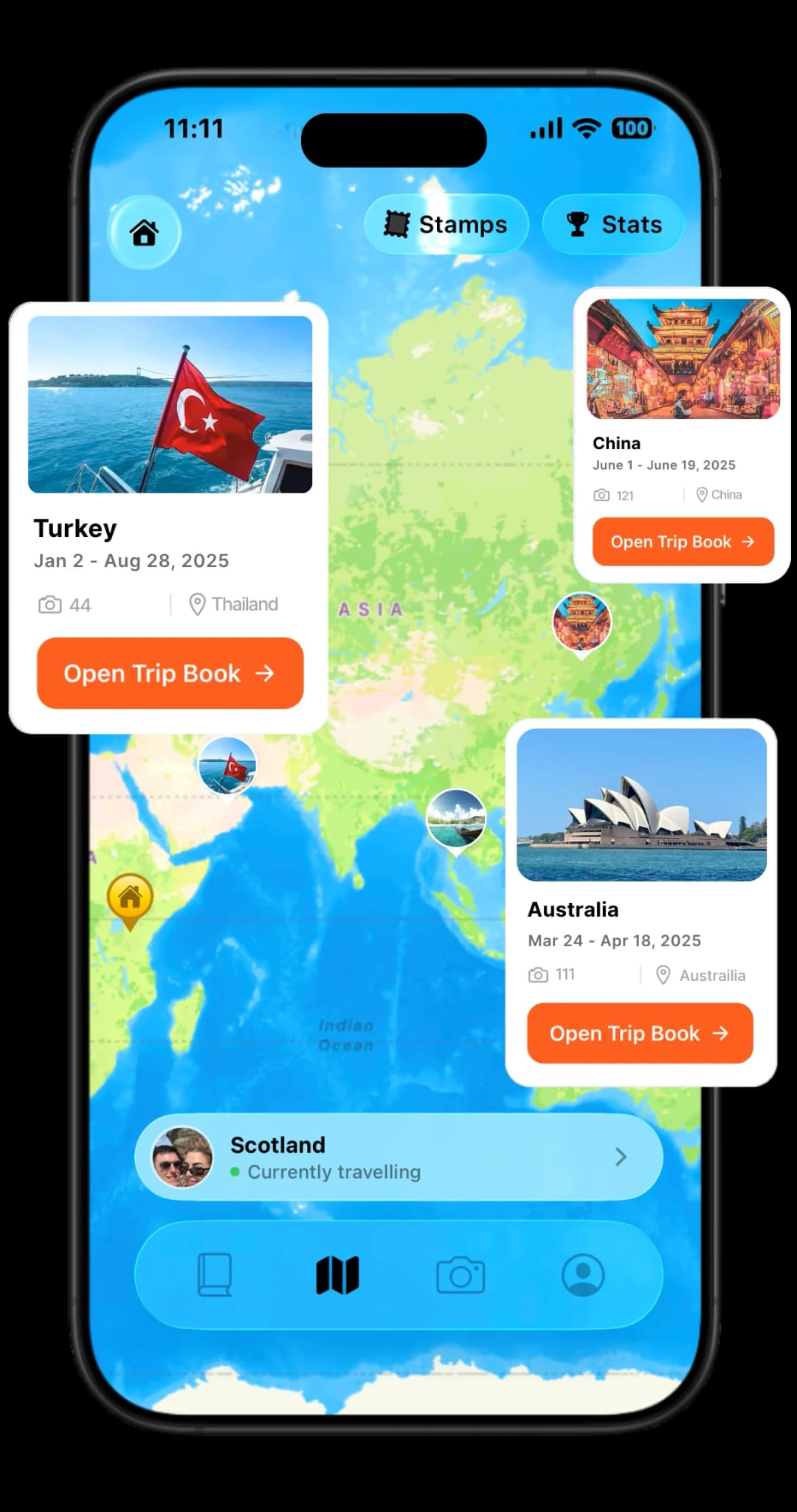
Save the route, photographs and small moments that made the journey worth remembering. TripMemo turns them into a private map and beautiful digital tripbook.
Clear answers without pretending the science is simpler than it is.
How accurate is this flight carbon footprint calculator?
It is a planning estimate, not an aircraft-specific measurement. The calculator uses great-circle distance, a route uplift, distance-band emission factors and cabin-space multipliers. The real result varies with aircraft, load, weather, routing and freight. We show a range to make that uncertainty visible.
What is the difference between CO₂ and CO₂e?
CO₂ measures carbon dioxide from burning jet fuel. CO₂e expresses the wider climate effect in an equivalent carbon-dioxide amount. Aviation also affects climate through nitrogen oxides, water vapour and contrails, so the CO₂e estimate is higher and more uncertain.
Why does business or first class produce more emissions?
Premium seats occupy more cabin floor area, so fewer passengers share the flight’s emissions. The effect is greatest on long-haul aircraft, where business and first-class seats can use several times the space of an economy seat.
Is a direct flight lower carbon than a connecting flight?
Usually. A connection adds distance and another take-off and climb, the most fuel-intensive stages of a flight. This tool lets you add a stop so you can compare the two itineraries.
Does a return flight double the emissions?
This calculator estimates a return as two equivalent flight legs, so the displayed result is twice the one-way estimate. Actual outbound and return emissions can differ because of winds, routing and aircraft.
Does the result include airport travel or the hotel?
No. It covers the passenger’s estimated share of the flight only. Transport to the airport, accommodation, food and activities are outside the calculation.
Can I use this result for formal carbon reporting?
Use it for personal planning and route comparison. Organisations preparing audited inventories should apply the conversion factors and reporting boundary required by their jurisdiction or use a licensed route-level dataset.
How can I reduce the footprint of a flight?
Fly less often, choose direct routes, use economy class, take rail where practical and combine short trips into a longer stay. Newer aircraft may help, but the largest reliable reductions usually come from avoiding a flight or reducing distance.
Why do flight carbon calculators give different answers?
Calculators use different boundaries and assumptions. Results change with the distance correction, aircraft and load data, cargo allocation, cabin multipliers, fuel-production emissions and whether contrails and other non-CO₂ effects are included. Compare like with like: check whether a result is one way or return, per passenger or total, and CO₂ or CO₂e.
What are radiative forcing and wider climate effects?
Aircraft affect climate through more than carbon dioxide. Nitrogen oxides, water vapour, soot and contrail-cirrus can alter atmospheric warming at altitude. A multiplier is a simplified way to represent these wider effects as CO₂e. Scientific uncertainty is higher than for direct fuel-burn CO₂, which is why this calculator lets you switch the multiplier off.
Are flight carbon offsets included?
No. The result estimates emissions produced by the flight before any offset or carbon-removal purchase. Buying an offset does not change the amount emitted by the aircraft, and the quality and permanence of offset projects vary.
Does sustainable aviation fuel make a flight carbon neutral?
Not automatically. Sustainable aviation fuel may reduce lifecycle greenhouse-gas emissions compared with fossil jet fuel, but reductions depend on the feedstock, production energy, blend percentage and accounting method. Most flights use a blend rather than 100% sustainable fuel, so this calculator does not assume a route-specific reduction.
Why can a short flight emit more CO₂ per kilometre?
Taxi, take-off and climb require substantial fuel regardless of total route length. On a short flight, those stages make up a larger share of the journey, so average emissions per passenger-kilometre are often higher even though the total footprint is lower than for a long-haul flight.

.webp&w=48&q=75&dpl=dpl_Hd3wSuHmxqjUKgf4qBK3NsyAazNN) TripMemo for iPhone
TripMemo for iPhone.webp&w=96&q=75&dpl=dpl_Hd3wSuHmxqjUKgf4qBK3NsyAazNN)