Nordic
5 countries
Denmark, Finland, Iceland, Norway, Sweden. Defined by the Nordic Council. Includes Atlantic Iceland and Finno-Ugric Finland alongside the three Scandinavian states.
Free Nordic travel tracker
Click each of the 5 Nordic countries you have travelled to — Denmark, Finland, Iceland, Norway, Sweden. Tracks Scandinavia and EU progress. Saves locally, shareable in one click.
There are 5 Nordic countries:
All five Nordic countries are in the Schengen Area. Three of them — Denmark, Finland, and Sweden — are also EU member states. Iceland and Norway are not in the EU but joined Schengen via the European Economic Area (EEA) agreement. The Nordic Passport Union has allowed free movement between the five countries since 1952.
The five Nordic Council member states with capital, language, currency, population, area, and EU/Schengen membership.
| Country | Capital | Language | Population (M) | Area (km²) | Currency | Scand. | EU | Schengen |
|---|---|---|---|---|---|---|---|---|
| Denmark | Copenhagen | Danish | 5.97 | 42,933 | Danish krone (DKK) | ● | ● | ● |
| Finland | Helsinki | Finnish, Swedish (official) | 5.55 | 338,145 | Euro (EUR) | ○ | ● | ● |
| Iceland | Reykjavík | Icelandic | 0.39 | 103,000 | Icelandic króna (ISK) | ○ | ○ | ● |
| Norway | Oslo | Norwegian | 5.55 | 385,207 | Norwegian krone (NOK) | ● | ○ | ● |
| Sweden | Stockholm | Swedish | 10.61 | 450,295 | Swedish krona (SEK) | ● | ● | ● |
● Scandinavia (DK, NO, SE) · ● EU member · ● Schengen Area. Iceland and Norway are in Schengen via the EEA agreement, not the EU. Population estimates 2025/2026.
A quick traveller’s read on each Nordic state — what makes it distinct, what it’s known for, and how it fits into the cluster.
Copenhagen · 6.0 M · 42,933 km²
The southernmost Nordic country and the only one connected by land to continental Europe. Copenhagen is the most-visited Nordic capital — flat, cycle-friendly, and packed with design, smørrebrød, and harbour bathing. Beyond the city, Denmark runs across the Jutland peninsula and several hundred islands; coastal towns like Aarhus and Skagen, and the cross-bridge route to Sweden via Malmö, make it the easiest Nordic country to add to a Europe trip.
Helsinki · 5.5 M · 338,145 km²
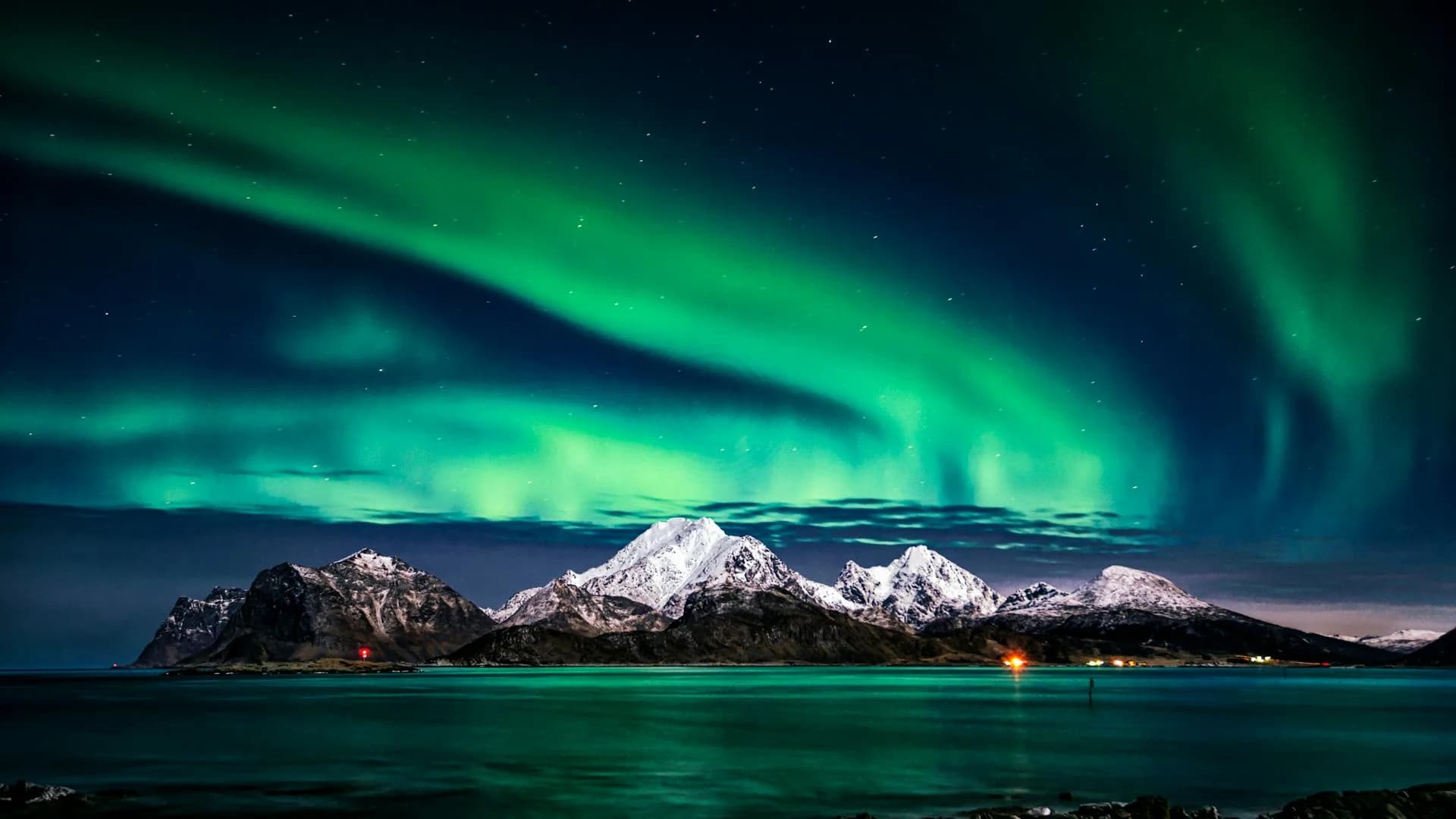
The eastern edge of the Nordics, sharing a long border with Russia and the only Nordic country that uses the euro. Finnish is unrelated to the other Nordic languages, which is why Finland is Nordic but not Scandinavian. Helsinki is small, modern, and right on the Baltic; head north to Lapland for the northern lights, husky safaris, and Santa Claus marketing in Rovaniemi.
Reykjavík · 0.4 M · 103,000 km²
A volcanic North Atlantic island that is Nordic but not Scandinavian — geographically far from the peninsula and culturally its own thing. Iceland is in the Schengen Area and the EEA, but not the EU. Most travellers do the Ring Road or a Reykjavík + Golden Circle short trip; in winter the country is one of the most reliable places on Earth to see the northern lights.
Oslo · 5.5 M · 385,207 km²
The fjord country — long, thin, and dramatic, stretching from Oslo in the south to North Cape above the Arctic Circle. Norway is in Schengen and the EEA but voted twice against EU membership; prices are the highest in the Nordics. The classic trip is Oslo → Bergen → fjords (Geiranger, Nærøyfjord) → Lofoten Islands. The Hurtigruten coastal ferry is one of the great rail-replacement journeys in Europe.
Stockholm · 10.6 M · 450,295 km²
The largest Nordic country by area and population, occupying the eastern half of the Scandinavian Peninsula. Sweden is in the EU and Schengen but kept its own currency. Stockholm spans 14 islands and is widely seen as the prettiest Nordic capital. Beyond the city, Swedish Lapland (Kiruna, Abisko) and the west-coast archipelago around Gothenburg are the headline trips.
Three self-governing territories sit inside the Nordic family but aren’t separate UN countries. They aren’t included in the 5-country map above, but most travel writing treats them as distinct destinations.
Tórshavn · 54k · part of Denmark
A self-governing archipelago of 18 islands between Iceland and Norway. Part of the Kingdom of Denmark but not in the EU, Schengen, or the eurozone.
Nuuk · 56k · part of Denmark
The world’s largest island. Self-governing within Denmark; left the European Communities in 1985 and is not in the EU or Schengen.
Mariehamn · 30k · part of Finland
A demilitarised, Swedish-speaking autonomous region of Finland in the Baltic Sea. In the EU and Schengen, but with its own tax status.
The Nordic countries are the 5 members of the Nordic Council: Denmark, Finland, Iceland, Norway, and Sweden. They share strong historical, cultural, and political ties — and a famously high cost of living.
Five: Denmark, Finland, Iceland, Norway, and Sweden. Three autonomous territories (Faroe Islands, Greenland, and Åland) are sometimes counted as separate places to visit, bringing the total to eight.
"Scandinavia" strictly means three countries — Denmark, Norway, and Sweden — that share Germanic Scandinavian languages and a shared peninsula. "Nordic" is the broader term that adds Finland (which speaks a Finno-Ugric language, not Scandinavian) and Iceland (which sits in the Atlantic).
Geographically and politically yes, culturally and linguistically not really. Finland is firmly Nordic and a member of the Nordic Council, but Finnish is unrelated to Danish, Norwegian, and Swedish. Most travel writing uses "Nordic" when including Finland.
Iceland is Nordic, not strictly Scandinavian. It sits in the North Atlantic, was settled by Norse Vikings, speaks a North Germanic language, and is a member of the Nordic Council — but the "Scandinavian peninsula" doesn’t include it.
The Faroe Islands are a self-governing nation within the Kingdom of Denmark, not an independent country. They have their own parliament, currency (the Faroese króna, pegged to the Danish krone), and football team. They are not in the EU, Schengen, or the eurozone.
Greenland is part of the Kingdom of Denmark and a Nordic Council participant, but not a separate UN country. It is the world’s largest island, has its own self-government, and left the European Communities in 1985 — so it is not in the EU.
No — Estonia is a Baltic country, not a Nordic one. It shares some cultural and linguistic ties with Finland (the languages are related) and Estonia has lobbied to be considered Nordic, but it is not a member of the Nordic Council.
Three of the five: Denmark (joined 1973), Finland (1995), and Sweden (1995). Iceland and Norway are not EU members but are part of the European Economic Area (EEA) and the Schengen Area.
Yes — all 5 Nordic countries are in Schengen. Iceland and Norway joined via the EEA agreement rather than EU membership. There is also a long-standing Nordic Passport Union that has allowed free movement between the Nordics since 1952.
Only Finland uses the euro. Denmark uses the Danish krone, Iceland the Icelandic króna, Norway the Norwegian krone, and Sweden the Swedish krona. Despite the similar names, the four krone/krona currencies are not interchangeable.
Danish, Norwegian, Swedish, and Icelandic are all North Germanic languages and broadly mutually intelligible (especially the first three). Finnish is Finno-Ugric and unrelated. Sami minorities speak Sami languages across northern Norway, Sweden, and Finland. English is widely spoken everywhere.
Norway has the highest GDP per capita in the Nordics, driven by oil and gas. Iceland and Denmark also rank near the top globally. Sweden is the largest economy by total output.
Among the five Nordics, Sweden and Finland tend to be slightly cheaper than Norway, Denmark, and Iceland — especially outside the capitals. The Baltic states (Estonia, Latvia, Lithuania) are usually pitched as the "cheaper alternative" to the region overall.
June to August for long days and the best hiking, August for fewer crowds, late September to March for the northern lights (best in northern Norway, Iceland, and Finnish Lapland). Christmas markets are a December highlight in Denmark and Sweden.
The most common definitions are (1) you set foot on the soil and (2) you spent at least one night. Pick a rule that feels honest and stick to it.
Yes. Your visited list is stored in your browser’s local storage and is also encoded in the share link. Reset clears it instantly. Nothing is uploaded to TripMemo.
Methodology
Last updated 7 May 2026. The country list follows the Nordic Council’s official five-state membership. EU and Schengen membership reflect the latest official lists. The map renders from the same world-map.svg used by the Visited Europe Map, cropped to a Nordic-only viewBox.
TripMemo is not a government service. We do not store your visited list — it lives only in your browser.
All travel tools