


Max
Co-Founder, TripMemo
10 min read•Published
Summary
Learn how to create a photo journal that captures the full story of your travels—not just what you saw, but how it felt. Includes organization systems, caption techniques, and real examples.
You took 2,000 photos on your last trip.
You've looked at maybe 50 of them since returning home.
The rest sit in your camera roll, unsorted, unnamed, slowly fading from memory. In two years, you won't remember why you took half of them.
This is the problem with modern travel photography: we capture everything but preserve nothing.
A photo travel journal solves this. It combines your photos with context, captions, and story—transforming a chaotic camera roll into a narrative you'll actually revisit.
This guide shows you exactly how to create one.
What Makes a Photo Journal Different from a Photo Album
| Photo Album | Photo Journal |
|---|---|
| Chronological dump of images | Curated selection with intent |
| No context beyond date | Story, context, emotions captured |
| Rarely revisited | Regularly enjoyed |
| Passive storage | Active memory trigger |
A photo journal isn't about having more photos—it's about having meaningful photos with the words that bring them to life.
The Three Types of Photo Travel Journals
Type 1: The Visual-Heavy Journal
Photos: 80% | Text: 20%
Best for: Visual people who struggle with writing, quick documentation
Structure:
- 5-15 photos per day
- 1-2 sentence captions per photo
- Short daily summary (3-4 sentences max)
Example day spread:
[Photo: Morning coffee on balcony with city view] First coffee overlooking the rooftops. The church bells started at 7am and didn't stop until 7:45.
[Photo: Narrow market alley with hanging fabrics] The souk was overwhelming in the best way. Got lost for two hours.
[Photo: Plate of tagine] Lamb tagine at the riad. Sweetest apricots I've ever tasted.
[Photo: Sunset from terrace] Watched the sunset with mint tea. This is why I came.
Day Summary: Market in the morning, got lost (intentionally), found the best tagine of my life, mint tea at sunset. Tomorrow: the tanneries.
Type 2: The Narrative Journal
Photos: 50% | Text: 50%
Best for: Storytellers, those who want to remember feelings, writers who also love photos
Structure:
- 3-8 photos per day (highly curated)
- Extended captions that tell mini-stories
- 2-3 paragraph daily reflection
Example entry:
[Photo: Crowded train platform]
The Wrong Train to Agra
We got on the wrong train. Realized 30 minutes in when the landscape looked nothing like what the guide described. The ticket collector was somehow unsurprised—apparently this happens constantly.
Two hours later, back at the station, we found the right platform. The man selling chai laughed when I told him what happened. "Welcome to India," he said, pressing a cup into my hands. "You're learning."
[Photo: Taj Mahal at sunrise]
The Taj was worth the chaos. That's the thing about traveling here—everything is harder than it should be, and also more beautiful than you imagined.
Type 3: The Hybrid Scrapbook
Photos: 60% | Text: 30% | Ephemera: 10%
Best for: Creatives, tactile learners, memory collectors
Structure:
- Mix of photos, tickets, maps, receipts
- Handwritten notes alongside printed photos
- Physical or digital collage format
What to include:
- Photos (obviously)
- Screenshots of maps showing routes
- Ticket stubs or digital boarding passes
- Currency photos
- Menu screenshots or photos
- Voice memo transcripts
- Local art/design inspiration
How to Take Photos Worth Journaling
Not every photo deserves a caption. Here's how to take intentional photos that tell a story:
The Photo Types That Trigger Memories
1. Establishing shots
- Where you are (the view, the scene, the vibe)
- First impression moments
- "This is what it looks like here"
2. Detail shots
- Textures: cobblestones, fabrics, food surfaces
- Hands: yours, locals', artisans'
- Small things: door handles, menus, coins
3. Process shots
- Food being prepared (not just served)
- People working
- Things in motion
4. Mood shots
- The light
- Weather conditions
- Quiet moments between activities
5. Context shots
- Where you stayed
- What you wore
- What you carried
The "Story Stack" Technique
For any significant moment, capture 3-5 photos that tell the complete story:
Example: A Market Visit
- Wide: The entrance, the chaos, the colors
- Medium: A specific stall that caught your eye
- Close: The texture of the spices/fabrics/pottery
- People: The vendor, or your companion looking at something
- Souvenir: What you bought (or almost bought)
Now you have a complete visual story, not just a random snapshot.
Join the TripMemo
Newsletter
Unsubscribe anytime. Read our privacy policy.
The Caption Formula: What to Write
The worst caption: "Beautiful sunset"
The best captions include at least one of these elements:
The STORY Framework
S - Sensory detail What did it smell/sound/taste/feel like?
T - Time & Temperature When was this? What was the weather?
O - Observation What did you notice that isn't visible in the photo?
R - Reaction How did you feel? What did you think?
Y - You were here A specific detail that proves you experienced this
Caption Examples
Before (generic):
"Dinner in Rome"
After (using STORY):
The waiter didn't give us menus—just asked what we wanted. I said "whatever you'd cook for yourself" and he smiled like we'd passed a test. Cacio e pepe arrived in a pan, still crackling. The pepper made my nose run. I didn't care. This is what pasta is supposed to taste like. (9:45pm, still warm enough to sit outside)
Organization Systems That Actually Work
System 1: Day-by-Day (Best for TripMemo)
- One entry per day
- 5-15 curated photos per day
- Brief captions + daily summary
- Works perfectly with apps that auto-organize by date
System 2: Theme-Based
Group photos by theme rather than chronology:
- Food & drinks
- People & portraits
- Architecture & places
- Nature & landscapes
- Street life & culture
- Moments & feelings
Good for longer trips where daily organization gets overwhelming.
System 3: Moment-Based
Each entry = one significant moment, regardless of when it happened:
- "The wrong train"
- "The market vendor who taught me to haggle"
- "The sunset we almost missed"
- "The best meal of the trip"
Good for storytellers who want narrative over chronology.
The Photo Curation Process
You took 200 photos today. Your journal needs 10.
Here's how to choose:
Step 1: The 24-Hour Rule
Don't curate immediately. Wait until the next morning when urgency has faded and you can see which photos actually matter.
Step 2: The "Would I Print This?" Test
For each photo, ask: "Would I pay to print this and put it on my wall?"
If no, it probably doesn't belong in your journal either.
Step 3: The Story Check
Can you write something meaningful about this photo? If the best you can do is "nice view," skip it.
Step 4: The Variety Check
Do your selected photos show:
- Different times of day
- Different subjects
- Different distances (wide, medium, close)
- Different moods
If they're all the same type, cut some.
The Magic Number
5-10 photos per day is the sweet spot for most trips.
Less than 5: You'll wish you had more context More than 15: You'll never look at them all
Tools for Photo Travel Journals
Digital (Recommended)
| Tool | Best For | Photo Integration |
|---|---|---|
| TripMemo | Collaborative trips, visual journals | Excellent (auto-organizes by date/location) |
| Day One | Solo long-form writing | Good (manual organization) |
| Google Photos + Notes | Free/simple solution | Basic (separate apps) |
| Notion | Template lovers | Moderate (manual embedding) |
Physical
| Tool | Best For | Effort Level |
|---|---|---|
| Instax printer | Instant scrapbooking | Medium |
| Photo book services | Post-trip compilation | Low (after trip) |
| Traditional scrapbook | Creatives with time | High |
Our recommendation:
Use TripMemo during the trip (quick, automatic, cloud-backed), then print a physical book after if you want something tangible.
%20copy%202.avif&w=384&q=75&dpl=dpl_5LiWpjAxVHcJfxZ5FqYxsrCPPe5e)
%20copy%203.avif&w=384&q=75&dpl=dpl_5LiWpjAxVHcJfxZ5FqYxsrCPPe5e)
Your trips deservemore than a camera roll
.avif&w=96&q=75&dpl=dpl_5LiWpjAxVHcJfxZ5FqYxsrCPPe5e)
Real Photo Journal Examples
Example 1: Weekend City Break
Day 1 - Amsterdam
[Photo: Arriving at Amsterdam Centraal] The station alone is worth photographing. We hadn't even left the building yet and I'd already taken 20 photos. Bikes everywhere. More bikes than I've ever seen.
[Photo: Canal house reflection in water] First canal. The houses look like they're leaning on each other for support. Someone said it's because they used wooden foundations centuries ago. Now everything tilts.
[Photo: Indonesian rice table spread] Rijsttafel for dinner. 12 dishes I couldn't name but couldn't stop eating. The peanut sauce is the standard by which all future peanut sauces will be judged.
Day Summary: Arrival, canal wandering, ate too much. Feet: tired. Heart: full.
Example 2: Adventure Trip
The Glacier Hike (Day 5)
[Photo: Blue ice cave entrance]
Woke up at 5am to beat the crowds. The guide, Siggi, has done this hike 2,000+ times. "Every time different," he said, pointing to cracks that weren't there last week.
[Photo: Walking single-file across glacier]
The crampons feel alien for the first 10 minutes, then suddenly they feel like the only way to walk. The ice creaks beneath us. Siggi says that's normal. I choose to believe him.
[Photo: Inside the ice cave, blue light]
Inside the cave, sound disappears. The blue isn't like any blue I've seen—it's the blue that other blues want to be when they grow up. I stood there for 10 minutes saying nothing.
[Photo: Group photo with guide]
This is the face of someone who just walked on 1,000-year-old ice and feels very small in the best way.
Common Photo Journal Mistakes
- Over-curating - Including only "perfect" shots misses the authentic moments
- Under-captioning - "Paris Day 3" tells future-you nothing
- No people - Landscapes without humans feel empty years later
- Only highlights - The mishaps often make the best stories
- Waiting too long - Caption within 24 hours or lose the details
- No backup - Cloud sync your journal. Phones break.
Getting Started: Your First Photo Journal Entry
Try this exercise today with photos from your last trip:
- Pick 5 photos from one day
- For each photo, write 2-3 sentences using the STORY framework
- Write a 3-sentence summary of that day
- Read it back. Notice what memories surface that weren't in the photos.
That's a photo journal entry. That's all it takes.
The Goal Isn't Perfect—It's Preserved
A messy photo journal with 50 captioned photos is infinitely more valuable than a perfect camera roll with 2,000 unnamed images.
The photos are just triggers. The words are what bring them to life.
Start small. Caption something today.
Related Reading:
- 100+ Travel Journal Prompts
- How to Caption Travel Photos
- Photo Journaling Fundamentals
- Organize Thousands of Travel Photos
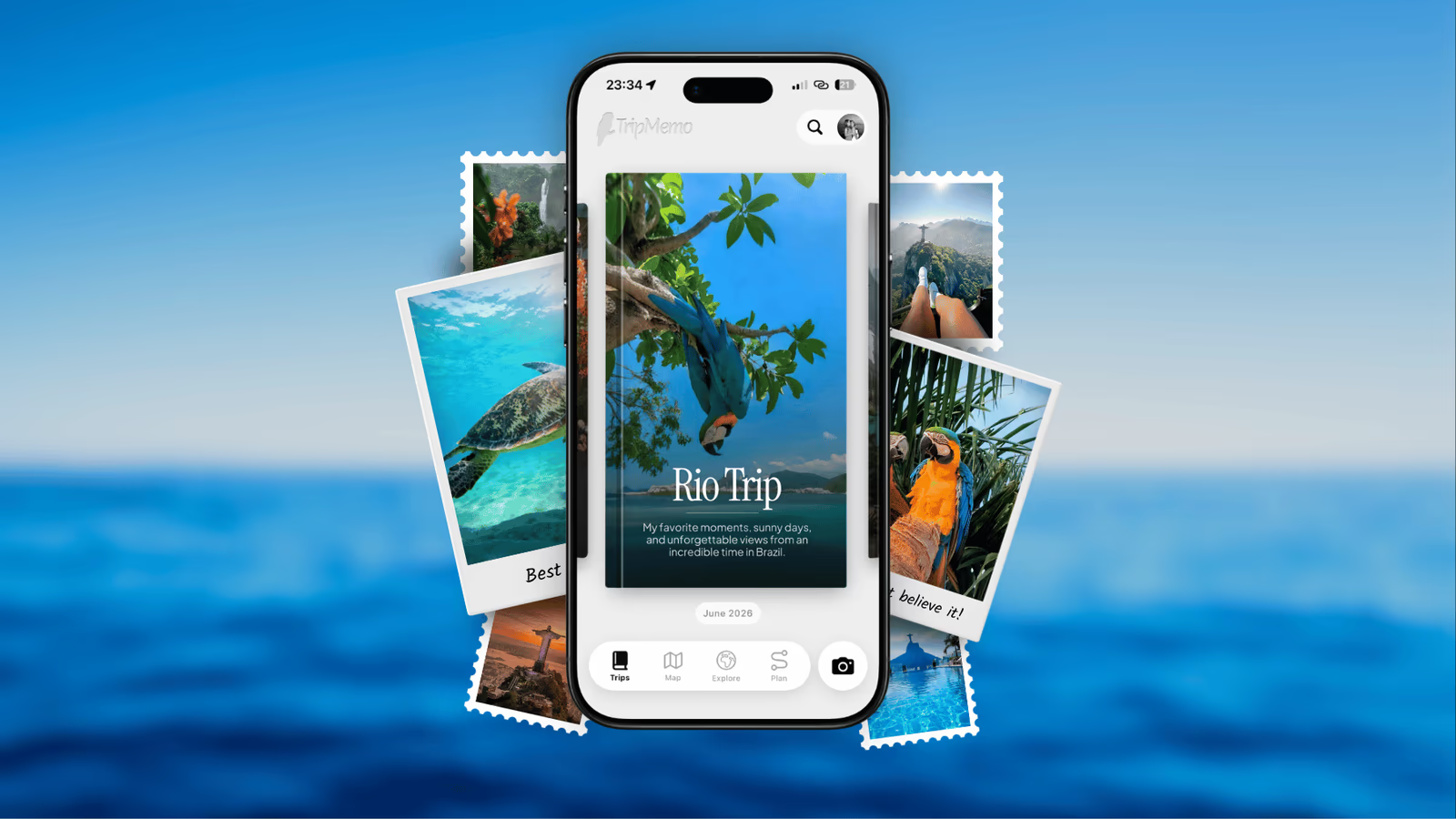
Ready to start your photo journal? TripMemo automatically organizes your travel photos by day and location—just add your captions and you have a complete visual travel journal.