


Samantha
Co-Founder, TripMemo
11 min read•Published
Summary
Instagram is a performance. A journal is a confession. Learn why keeping your travel memories private allows you to be more honest, vulnerable, and present.
We live in the age of the "Performative Trip."
If you didn't post the sunset on Instagram Stories, did it even happen?
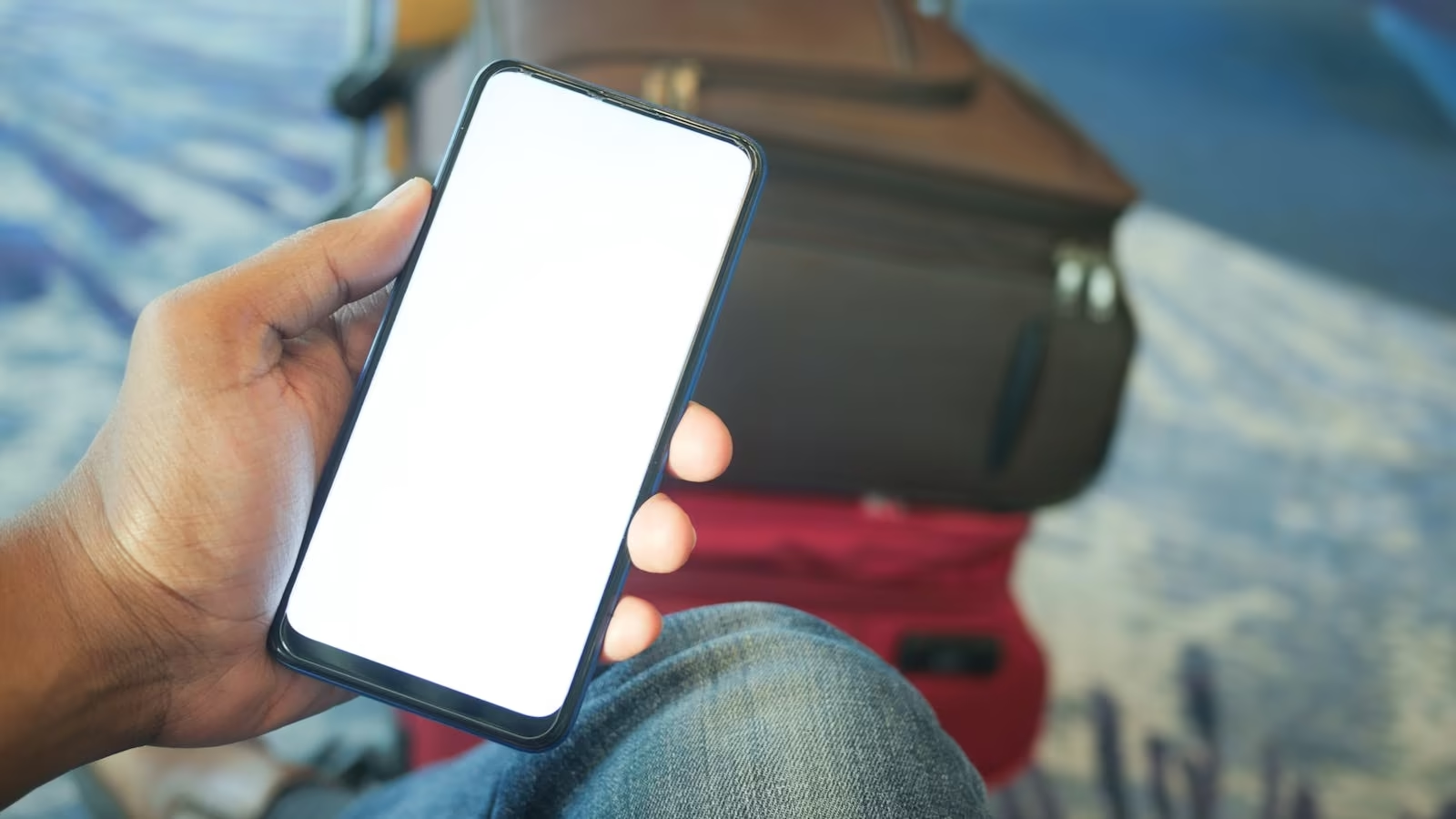
We curate our angles. We edit out the crowds. We write captions that sound witty and effortless. We wait for the perfect light, reshoot the same moment five times, and spend more time looking at our phones than the view in front of us.
But performance is exhausting.
And more importantly, performance changes the memory itself.
When you are shooting for an audience, you are looking for what they will like, not what you are feeling. You stop being an explorer and start being a content creator. The experience becomes raw material for a post rather than a moment to live in.
This is the case for the Private Travel Diary.
Whether it's a locked digital journal on TripMemo or a physical book hidden in your bag, privacy is the key to authenticity. Here's why keeping your memories off social media might be the best decision you make for your next trip.
1. You Can Admit You Hated It
On Instagram, you have to say: "Paris is magical! ✨"
In your private journal, you can say: "The Eiffel Tower was surrounded by aggressive sellers, the subway smelled like urine, and I am so tired of croissants. Why did I think this would be romantic?"
This honesty is vital.
If you force yourself to be positive all the time, you create a cognitive dissonance. You gaslight yourself into thinking every moment was perfect when some of them genuinely weren't. Over time, this disconnect between your real experience and your public narrative creates a strange emptiness.
Admitting that a famous sight was disappointing is actually liberating. It clears the way for you to find what you actually like—the hidden alley that wasn't on any list, the random conversation with a local, the meal you stumbled upon by accident.
Your honest reactions are data. They tell you who you are as a traveler. They help you plan better trips in the future. Social media strips away this self-knowledge because it only accepts the highlight reel.
2. You Can Be Ugly
Public travel content is about aesthetic perfection. The right outfit. The golden hour. The composed shot.
Private journaling is about raw reality.
- Write about your food poisoning.
- Write about the fight you had with your partner over Google Maps.
- Write about feeling lonely in a crowded hostel.
- Write about crying in an airport.
- Write about the anxiety attack at the train station.
These "ugly" moments are the real texture of travel. They are the challenges you overcame. They are proof that you are human. If you edit them out, you edit out your own growth.
Psychologists call this "narrative identity"—the story we tell ourselves about who we are. When you only document the beautiful moments, you create a false narrative. When you document everything—including the struggle—you create a complete one.
Years from now, the messy entries will mean as much as the perfect ones. Maybe more.
3. The "Audience of One"
When you write for an audience, you subconsciously censor yourself. You avoid topics that are too niche, too weird, or too personal. You write what you think will get likes, not what is true.
When you write for an audience of one (your future self), you can get weird.
- You can spend 3 pages describing a specific door handle that fascinated you.
- You can write bad poetry about the rain.
- You can glue in a sugar packet from a café.
- You can draw a crooked map of the streets you walked.
- You can write in sentence fragments. Or no sentences at all.
Your future self doesn't care about "likes." Your future self cares about the truth—the small, strange, specific truth of what it was like to be you in that place at that time.
This freedom is psychologically powerful. Research on self-determined motivation shows that activities we do for ourselves (intrinsic motivation) are more satisfying and sustainable than activities we do for external validation (extrinsic motivation). A private journal is purely intrinsic. It belongs only to you.
4. Breaking the Dopamine Loop
Posting on social media triggers a dopamine loop. You post. You check for likes. You check for comments. You check for validation. Your brain becomes conditioned to seek the next hit of approval.
This pulls you out of the present moment. You are physically in Bali, but mentally in your Notification Center. You're half-experiencing the sunset because the other half of your brain is wondering if anyone has seen your Story.
Neuroscientists call this "continuous partial attention"—and it's the enemy of deep experience and lasting memory formation.
A private journal breaks this loop.
You document the moment, and then... nothing happens. No ding. No heart icon. No follower count.
The satisfaction comes from the act of documenting, not the external validation. It rewires your brain to find joy in the experience itself. Over time, you become less dependent on the approval of strangers and more attuned to your own internal compass.
This isn't just about travel. It's about reclaiming your attention from the attention economy.
5. Safety and Security
This is practical but often overlooked.
Posting your location in real-time is a security risk.
"Hey everyone, I'm at this hotel!" tells potential thieves exactly where you are (and that your home is empty). Geotagged photos reveal patterns. Public travel announcements are essentially security vulnerabilities.
A private journal allows you to document your location precisely—for memory's sake—without broadcasting it to the world. You can record the name of the hotel, the address of the restaurant, the exact coordinates of that perfect beach, all without making that information public.
When you get home, you can choose what (if anything) to share. But the sharing becomes intentional, not impulsive.
6. The Paradox of Sharing Everything
There's a strange phenomenon that happens when we share too much: the experience starts to feel less ours.
When you post a moment immediately, you hand it over to the public. It becomes content. It gets likes, comments, reposts. Other people's reactions shape how you feel about it. The memory becomes entangled with the social response.
When you keep a moment private, it remains purely yours. It lives in your journal and your memory, unmarked by external judgment. There's an intimacy to that. A sacredness.
Some of the best travel experiences are the ones you never tell anyone about. They become secret treasures, known only to you. They prove that your life has value independent of anyone else's awareness of it.
How to Start the Detox
You don't have to delete Instagram. You don't have to go completely dark. Just change the order of operations.
The Rule: Write it first. Post it later.
When something amazing happens:
- Experience it. Put your phone down. Be there.
- Write it down. Capture it in TripMemo or your notebook. Include how you felt.
- (Optional) Post it later. If you still want to share, do it after you've left the location—or when you get home.
Make the memory yours before you make it theirs.
Additional Detox Strategies
- Delay posting by 24 hours. This breaks the real-time sharing habit and lets you be more intentional.
- Turn off notifications. You can check social media when you choose, not when it summons you.
- Designate "phone-free" moments. First hour of the morning. Meals. Sunsets. Sacred times.
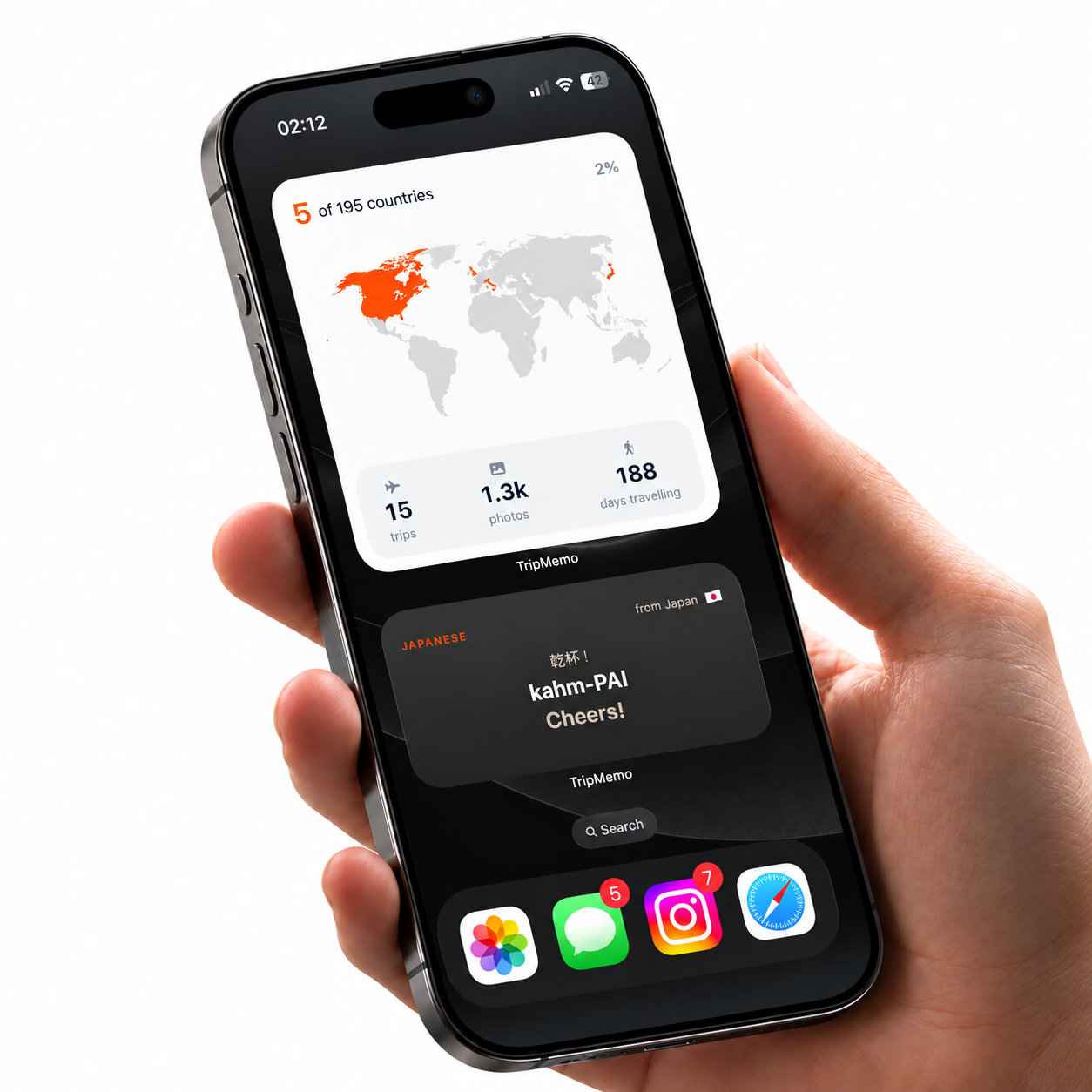
- Create a private TripBook. Use TripMemo's private mode to document your trip in real-time without any public sharing.
- Tell one person instead of everyone. Send a photo to a friend instead of posting it. Personal connection beats broadcast.
The goal isn't to become anti-social. It's to become pro-presence. To prioritize your own experience over the performance of that experience.
Join the TripMemo
Newsletter
Unsubscribe anytime. Read our privacy policy.
The Private Journal as Rebellion
In a world where everything is shared, privacy becomes a radical act.
Keeping a private travel diary is a statement: This moment is not for sale. This memory is not content. This experience belongs to me.
It's a rebellion against the attention economy, against the pressure to perform, against the erosion of interiority.
Your trip is not a product. Your memories are not currency.
A private journal is where you get to be fully yourself—messy, contradictory, disappointed, ecstatic, human. No filters. No audience. Just you and the truth of what happened.
That's worth more than any number of likes.
Learn More
Private Journaling FAQ
- Isn't sharing travel photos a way to stay connected with friends?
There's a difference between sharing and broadcasting. Sending a photo directly to a friend creates genuine connection. Posting to a public feed is more like performing for an audience. Consider sending personal messages to the people who actually care about your trip instead of posting to everyone at once.
- How do I resist the urge to post in the moment?
Try the "24-hour rule"—promise yourself you can post anything you want, but only after 24 hours. This breaks the impulsive habit. Often, by the next day, you'll realize you don't actually need to share it. Alternatively, capture the moment in TripMemo first—satisfying the urge to document without the public exposure.
- What if I want to remember places to recommend to others?
Your private journal is perfect for this. Document places in detail—TripMemo even auto-tags locations. When a friend asks for recommendations later, you can share selectively and personally. This is more meaningful than a public post anyway, because you're giving tailored advice to someone specific.
- Does social media really affect how I experience travel?
Research says yes. Studies show that people who photograph experiences primarily to share them report less enjoyment than those who photograph for personal memory. The awareness of an audience—even a potential one—shifts attention from experiencing to documenting-for-others. Going private removes this distortion.
- How do I explain to travel companions that I'm not posting?
You can simply say you're "doing a social media detox for the trip" or that you're "trying to be more present." Most people respect this and might even be inspired to join you. You can still take photos together—just save them for a private journal instead of public posting.
- Can I keep a private digital journal secure?
Yes. TripMemo is designed with privacy by default—your content is end-to-end encrypted and never shared publicly unless you explicitly choose to. Look for apps that prioritize local storage or encryption. For extra security, use your device's built-in privacy features like Face ID or passcode locks.
Related reading:
- Travel Photography for Memory, Not Instagram
- The Anti-Influencer Guide to Travel Photography
- The Complete Guide to Travel Journaling
- Your Travel Year in Review: A Private December Dump
Keep your memories private. TripMemo is designed for personal documentation, not social performance.